
Trivial Documents Report
Identify low-value or non-business-critical files such as system files, temporary files, logs, and other content with minimal business relevance.
The Trivial Documents screen helps you identify low-value or non-business-critical files within your environment. These include system-generated files, temporary files, logs, and other content that offers minimal business relevance.
This view supports storage optimisation and cleanup efforts by highlighting files that can typically be removed with low impact.
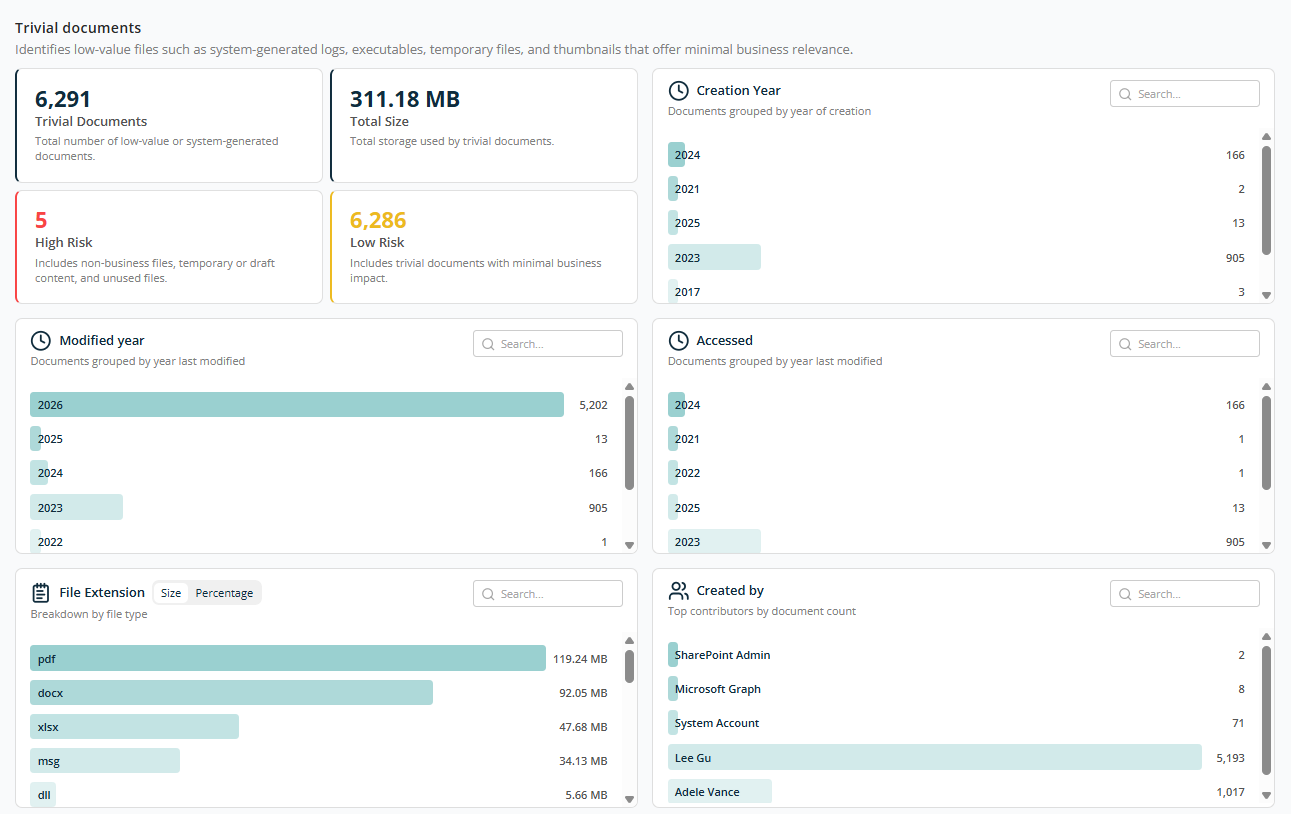
Overview
At the top of the screen, key metrics summarise trivial content:
- Trivial Documents — Total number of low-value or system-generated files.
- Total Size — Storage consumed by trivial documents.
- High Risk — Trivial files that pose higher governance risks. May include temporary or draft files containing sensitive information or misplaced system files in shared locations.
- Low Risk — Files with minimal business or compliance impact. Typically older, unused documents that can be cleaned up safely.
Creation Year
Shows trivial documents grouped by the year they were created. Helps identify how old the unused content is. Data is displayed in descending order. Use the Search box to locate a specific year.
Modified Year
Shows trivial documents grouped by the year they were last modified. Helps identify how long documents have remained unchanged. Use the Search box to locate a specific year.
Accessed
Shows trivial documents grouped by their last access (usage) year. Helps identify files that haven't been opened recently or are no longer actively used. Use the Search box to locate a specific year.
File Extension
Breaks down trivial documents by file type, such as PDF, DOCX, MSG, LOG, TEMP. You can switch between:
- Size view — Storage consumed by each file type.
- Percentage view — Relative contribution to trivial storage.
Created By
Shows trivial documents created by different users in descending order. Use the Search box to locate a specific user.
Report Filtering
For all panels, each bar is clickable. The entire report filters based on the selected record, and the selected criteria appear next to Filter by at the top of the report. You can filter on multiple criteria simultaneously.
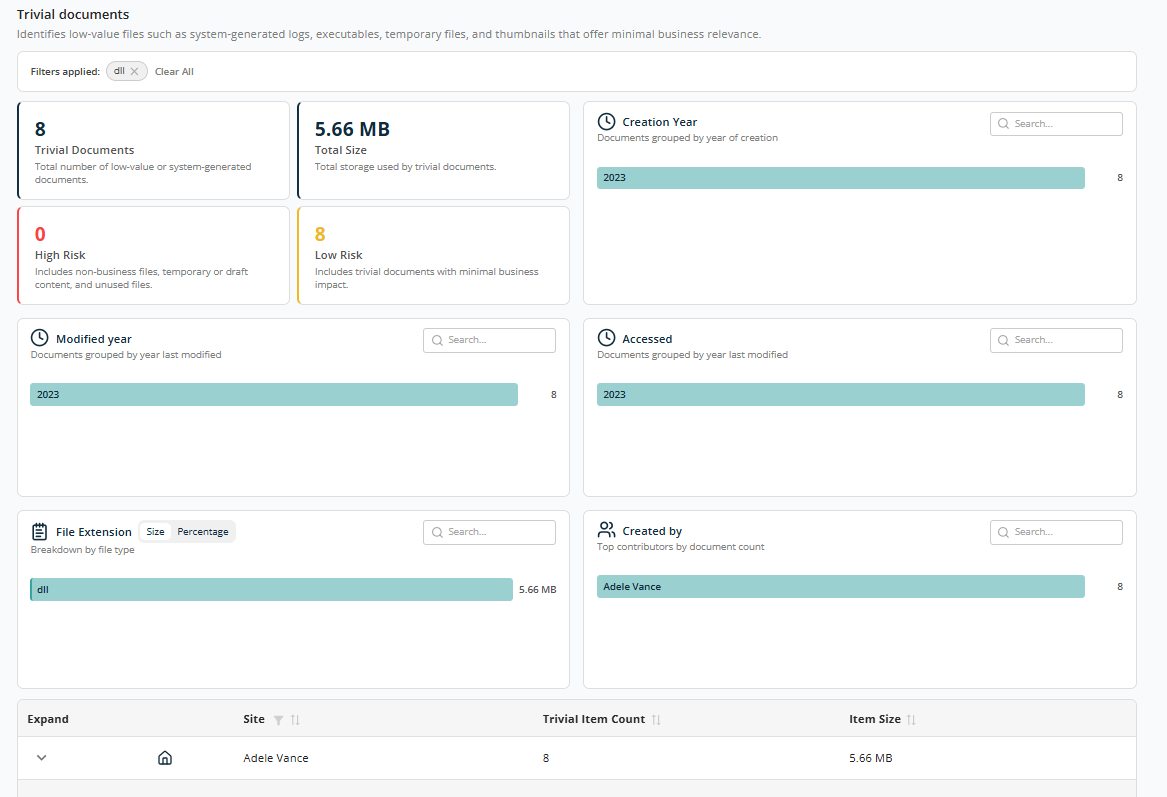
Table View
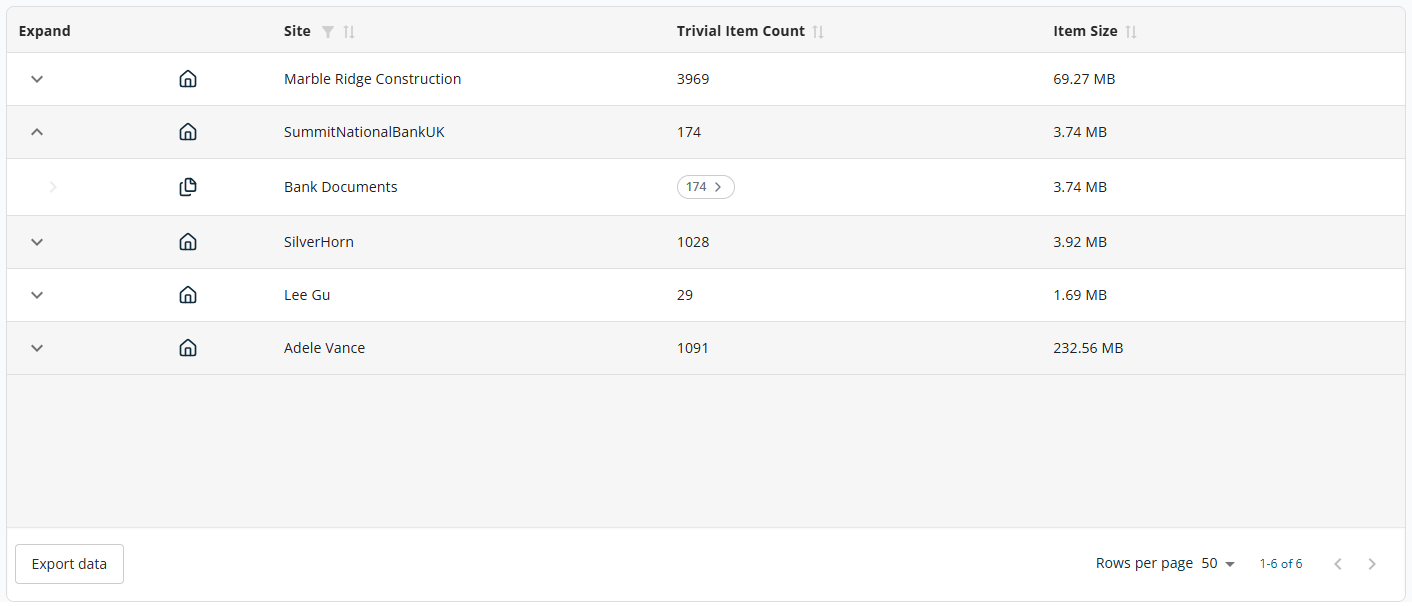
The table at the bottom of the screen shows details of trivial documents grouped by Site or OneDrive, with the following columns:
- Expand — Use the expand icon (arrow) to drill down into site-level or OneDrive-level details.
- Site — Name of the SharePoint site or OneDrive.
- Trivial Item Count — Total number of trivial documents in the site or OneDrive.
- Modified Year — Last modified year for the trivial items.
Sorting is available on Site, Trivial Item Count, and Modified Year. A filter is available for the Site column.
The table supports an expanded view for each row. Expanding a site displays specific locations within the site where trivial items exist.
The Export Data button at the bottom left of the table downloads the report for offline analysis or reporting.
At the bottom right of the table:
- Rows Per Page — 5, 10, 15, 20, 25, 30, 50, or 100. Default: 10.
- Total Record Count — Range and total record count.
- Next/Previous Navigation — Arrow icons to navigate.
In the expanded view, clicking on a trivial item count opens a side panel listing the trivial documents in that library or OneDrive location.

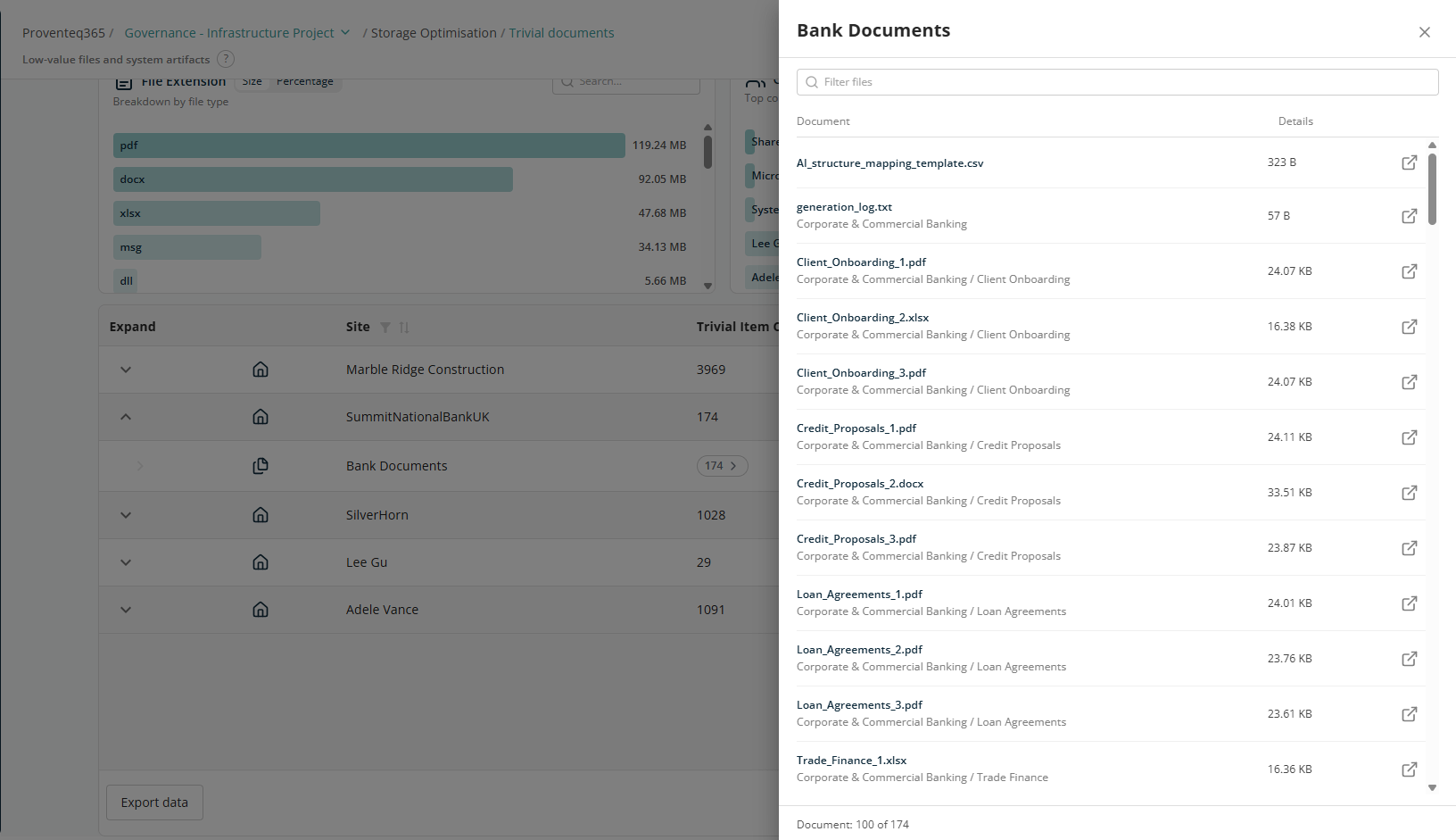
Each record has an icon to open it in another browser tab.